Signs Your Relationship Is Ending Often Show Up Years Early. What a Big Study Found, and What to Say While There’s Still Time
A study of four national surveys found that satisfaction fades in two stages before a breakup: a slow slide that can last years, then a sharp drop starting one to two years before the split. Here’s how to tell a rough patch from real decline, and what to say.

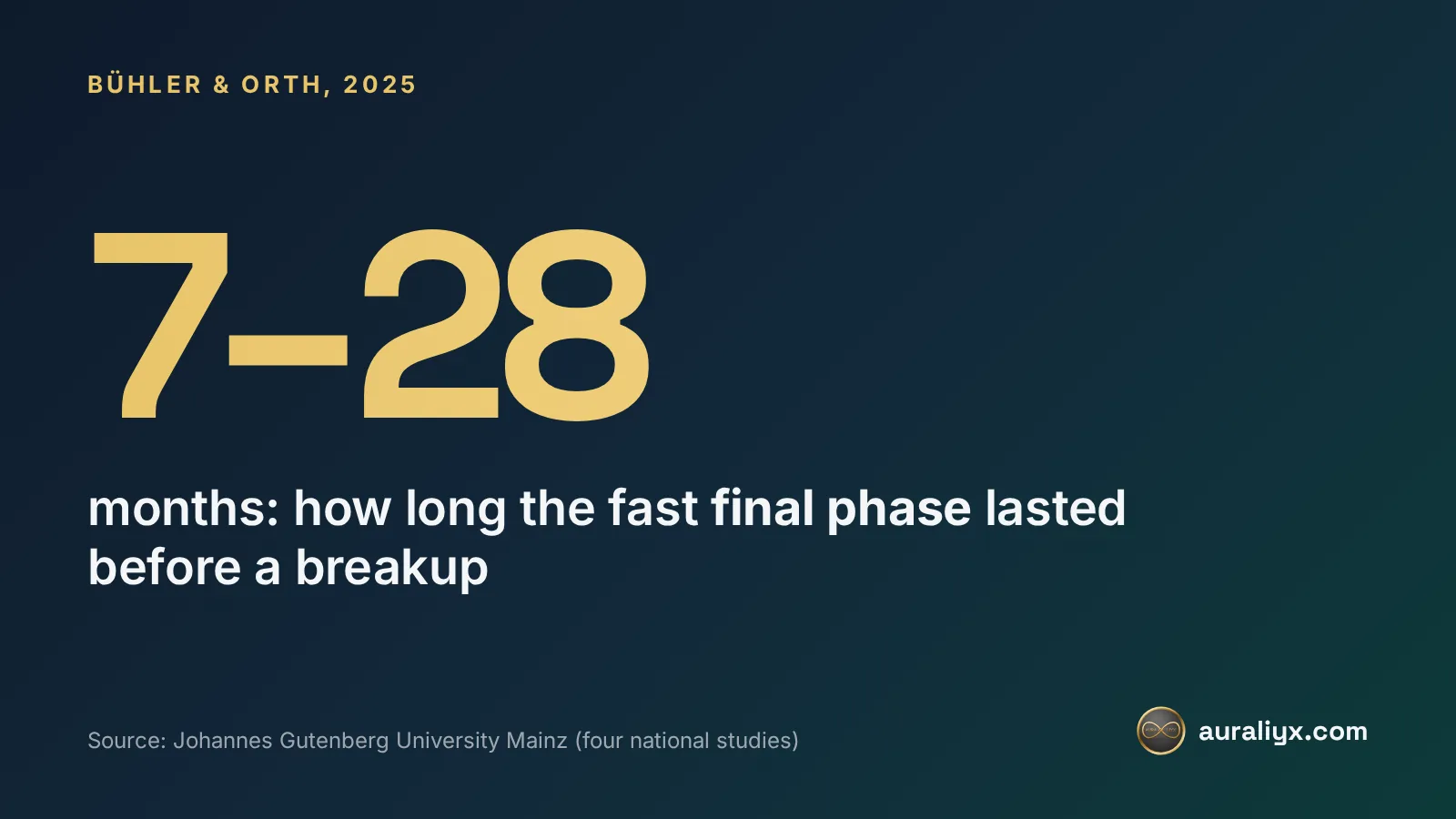
The clearest signs your relationship is ending are rarely one big event. In a 2025 study by Janina Bühler and Ulrich Orth, published in the Journal of Personality and Social Psychology and based on four national surveys, relationship satisfaction declined in two stages before a breakup: a slow, small drop that could last years, then a turning point about one to two years before the split, followed by a fast slide lasting 7 to 28 months. Day-to-day ups and downs are normal. A steady, months-long slide, especially when you stop feeling heard, is the signal to talk now.
- In four national surveys (987 to 3,373 people per survey who later broke up), satisfaction fell in two stages before the breakup: slow first, then fast.
- The fast final stage began about one to two years before the split and lasted 7 to 28 months.
- The person who is left often feels the drop much later, sometimes just months before the end.
- Day-to-day dips are normal; feeling that your partner responds to your needs was linked to steadier satisfaction.
- The slow first stage is the best time to speak up, ask for what you need and get help.
You can’t point to the day it changed. There was no big fight and no betrayal. Just more nights on opposite ends of the couch, shorter replies, and a quiet feeling that you’ve become roommates who share a Wi-Fi password.
If you’ve been wondering whether that feeling means something, research has a useful answer. Breakups rarely come out of nowhere. A large study that followed people for years found that relationships tend to fade in two stages, and the second, faster stage usually starts one to two years before the split.
The hopeful part is the first stage. It can be long, and it’s exactly where an honest conversation still has the most room to work.
What the study found: love fades in two stages
Psychologists Janina Bühler of Johannes Gutenberg University Mainz and Ulrich Orth of the University of Bern borrowed an idea from aging research called “terminal decline” and applied it to romance. Instead of asking how satisfaction changes from the start of a relationship, they asked how it changes as a breakup gets closer. Their paper was published in the Journal of Personality and Social Psychology in 2025.
They used four long-running national surveys from Germany, Australia, the United Kingdom and the Netherlands. Depending on the survey, 987 to 3,373 people who later separated were compared with a matched group of 1,351 to 4,717 people who stayed together. The surveys ran for 12 to 21 years, and people regularly rated how satisfied they were with their relationship. The pattern they found looked like this:
- Stage one, the slow slide. Satisfaction drops a little at a time, and this phase can last several years.
- The tipping point. A transition point arrives, on average one to two years before the breakup.
- Stage two, the fast slide. Satisfaction falls quickly. Across the datasets, this final phase lasted 7 to 28 months.
- Only couples who split went through stage two. The comparison group of people who stayed together did not show this sharp drop.
A note on the numbers: the university’s press release gives a total of 11,295 people, but the study’s abstract lists 987 to 3,373 people per survey in the groups that broke up and 1,351 to 4,717 in the comparison groups. We use the abstract’s numbers.
Why a breakup can feel sudden, especially if you’re the one left
The two partners don’t live these stages at the same time. The person who ends things usually becomes unhappy earlier. In one of the datasets, initiators began their steep decline more than a year before the breakup.
The person on the receiving end often doesn’t feel the sharp drop until much closer to the end, sometimes just a few months beforehand, and then it falls faster. That gap explains a lot of the “I never saw it coming” feeling. One partner has been quietly leaving for a long time; the other is only now catching up.
The researchers also found that people’s overall life satisfaction dropped much less than their relationship satisfaction. In other words, the slide was mostly about the relationship itself, not a general bad mood about life.
“Partners pass through various phases. They do not normally separate from one day to the next, and the way these phases impact on the two partners differs”
Janina Bühler, Johannes Gutenberg University Mainz
Something feels off and you don’t know how to bring it up? Talk it through with Auraliyx and find a gentle way to start.
Try Auraliyx free →Rough patch or real decline? How to tell the difference
One caveat: this study measured satisfaction scores, not behaviors, so it doesn’t hand you a checklist of warning signs. What it shows is a direction over time. A bad week is not a trend.
A second study from the same Mainz team backs that up. Researchers followed 593 couples in one survey and 150 in another, who rated their relationship daily or even several times a day. Satisfaction moved up and down a lot, and short dips sometimes came with thoughts of breaking up, but those dips had only a limited effect on how the relationship went over time. The factor that stood out was perceived responsiveness: feeling that your partner notices your needs and responds to them.
So instead of reading tea leaves in one cold text, ask yourself a few calmer questions:
- Is this a bad week or a slow slide over months? One fight is noise; a steady drop is a signal.
- Do you still feel noticed? When you share something that matters, does your partner respond, or does it disappear?
- Have you stopped bringing things up? Silence that comes from “what’s the point” is different from peace.
- Is the unhappiness mostly about the relationship? If work, friends and health feel fine but home feels heavy, that’s worth naming.
- Are the same fights coming back? If arguments keep circling back to bills, you’re not alone: in one survey, money topped couples’ list of stressors.
Why the slow stage is your best window to act
Bühler, who also works as a couples therapist, points out that many couples seek help too late, after the tipping point has already passed. Her advice is to act in the earlier, slower phase, before things begin to go rapidly downhill, when it “may thus be more effective and even contribute to preserving the relationship.”
That’s good news if something feels off. Feeling a little less close now and then is common, and on its own it says little about where you’re headed. Treat it as a reason to talk while you both still have the goodwill to listen.
Responsiveness is also personal. What makes one person feel cared for can leave another cold; even something as simple as touch varies, and some people genuinely dislike hugs. Asking “What makes you feel loved?” can reveal more than months of guessing.

What to say before it gets worse: messages that reopen the door
Starting the conversation is usually the hardest part. Lead with a feeling and a small, specific request, not a verdict on the whole relationship. If your partner has gone quiet or curt, this guide on answering a partner whose texts have turned cold can help you reply without making it worse.

Why it works: It names the feeling with warmth and offers a small, concrete plan instead of a judgment your partner has to defend against.
Why it works: It points to one moment, one feeling and one request. That makes it easy to respond to, and responsiveness is what the daily study linked to steadier satisfaction.
Why it works: It’s honest about the hurt but pauses the fight, so the conversation can happen when you’re both calmer.
If you think you’re already in the final stage
Sometimes the slide has been going on for a long time. If you’ve been checking out, or your partner seems to have, say it gently and directly instead of hoping it passes. “I’ve felt us drifting for a while, and I want to know how you’re feeling about us” is hard to say, but it’s kinder than months of silence.
A licensed couples therapist can help you both feel heard, whether you end up rebuilding or parting with less damage. If you do decide to separate, short, calm and respectful messages make everything that follows easier, especially if you share a home, money or children.
And if you were blindsided, be patient with yourself. You may simply have reached the hard part later than your partner did.
This article is general information, not mental health, legal or financial advice. If stress is affecting your health, you feel unsafe, or you’re facing decisions about money, a home or children, talk to a qualified professional.
Where this research stops short
These findings are strong because they come from large, long-running national samples. They still have limits worth knowing before you apply them to your own life:
- They are averages. No curve can tell you whether your relationship will last.
- All four countries are Western. The pattern may look different where norms around dating, marriage and divorce differ.
- People reported their own satisfaction, usually once a year, so the exact timing of the tipping point is approximate.
- It describes a pattern, not a cause. The decline is linked to breakups; it doesn’t show what triggered it, and a low score is not a sentence.
- Money Now Stresses Couples More Than Health, Work or Intimacy. Here's How to Talk About It Without a Fight
- Why Some People Love Hugs and Others Hate Them, According to a Study of 15,000 Adults
- U.S. Divorce Is Less Common Than It Used to Be: What the Latest CDC Numbers Show, and How Couples Can Bring Up Hard Things Early
Sources we checked
- Journal of Personality and Social Psychology (Bühler and Orth): Terminal decline of satisfaction in romantic relationships: Evidence from four longitudinal studies (March 20, 2025)
- Johannes Gutenberg University Mainz: Transition point in romantic relationships signals the beginning of their end (March 21, 2025)
- PsyPost: Romantic breakups follow a two-stage decline that begins years before the split, study finds (June 23, 2025)
- Johannes Gutenberg University Mainz: Satisfaction in romantic relationships significantly fluctuates over several days and even within a 24-hour period (June 16, 2025)
We open and read every source before we cite it. Spotted an error? Email humansupport@auraliyx.com and we will fix it.
Written by
Auraliyx is an AI relationship coach trained only on attraction, dating and relationships. Every article is built from sources we open and read, every number is checked against the original, and the Auraliyx team reviews it and corrects anything we get wrong.
Frequently asked questions
What are the signs your relationship is ending?
Research points less to single events and more to a steady, months-long drop in how satisfied you feel, often alongside feeling unheard and avoiding hard topics. A bad day or a single fight is normal; a long slide is the signal to talk.
How long before a breakup do problems start?
In a 2025 study of four national surveys, satisfaction declined slowly for years, then hit a turning point about one to two years before the breakup. The fast final phase lasted 7 to 28 months.
Is it normal for relationship satisfaction to go up and down?
Yes. A Mainz study of couples who rated their relationship daily found big swings from day to day, and short dips had only a limited effect on how relationships went over time.
Why didn’t I see the breakup coming?
The partner who ends things usually becomes unhappy earlier. The partner who is left often feels the sharp drop much later, sometimes just a few months before the end.
Can a relationship be saved once things get bad?
Sometimes, but earlier is easier. The lead researcher, who is also a couples therapist, says acting in the slower first stage may be more effective and may even help preserve the relationship.
When should we see a couples therapist?
When the same fights keep repeating, when you’ve stopped talking about what matters, or when one of you is thinking about leaving. Many couples wait until the decline is already steep.
Found it useful? Send it to someone who needs it
A friend with the same question will thank you.
Talk while it still helps
Paste your partner’s message or describe what’s been changing between you. Auraliyx helps you say what you feel clearly and kindly, and explains why each message works.
Try Auraliyx freeFree · no credit cardShort videos on what to text, what to say and what it really means. Follow Auraliyx:
Join the conversation
Has this happened to you? Share your experience. It might help someone else.
Comment rules
- Be kind. No insults, hate or explicit content.
- No links, ads, contact details or phone numbers.
- English only, for now.
- Don't share private details about other people.
- Comments are checked automatically and may be removed.
We only keep the first name and the comment you post, and the date. We don't ask for your email or store your IP address. To have a comment removed, email humansupport@auraliyx.com.