Money Now Stresses Couples More Than Health, Work or Intimacy. Here's How to Talk About It Without a Fight
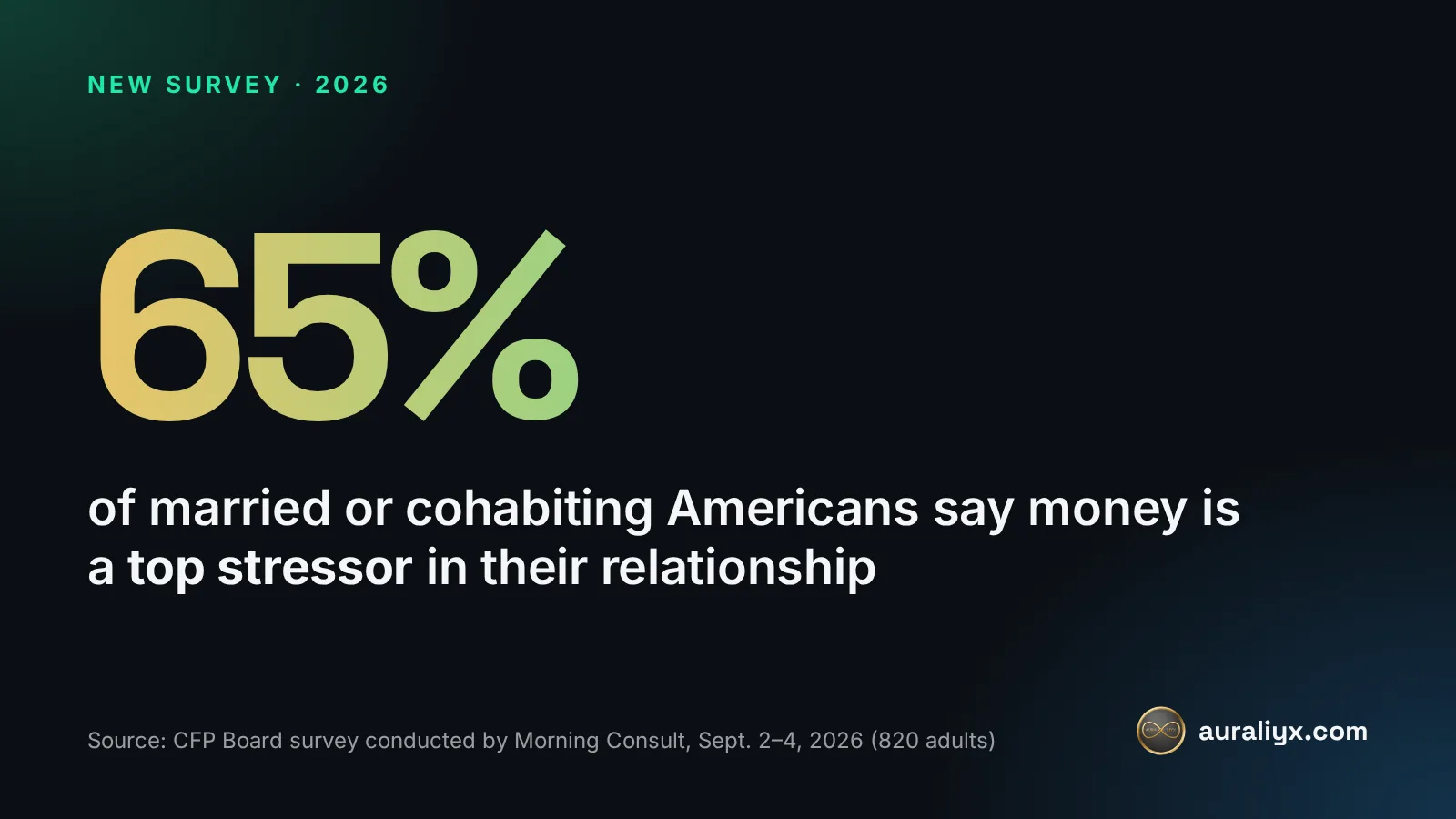
A new national survey found that 65% of married or cohabiting Americans call money a top source of stress in their relationship. Here is why money fights hit so hard, and the words that keep them calm.

In a CFP Board survey of 820 married or cohabiting Americans, conducted by Morning Consult on September 2 to 4, 2026, 65% said money is a top stressor in their relationship and 34% called it their number one, ahead of health (46%), work-life balance (36%) and intimacy (30%). The goal is not to agree on every dollar; it is to make money talks regular, specific and calm.
- 65% of married or cohabiting Americans call money a top relationship stressor; 34% say it is the number one.
- 46% say money is the most uncomfortable subject to discuss with their partner.
- 41% made a major financial decision in the past year without telling their partner.
- Earlier research from Kansas State University found money arguments were the strongest predictor of divorce among common disagreements.
- Short, regular money check-ins and a clear "let's talk first" spending limit prevent most blowups.
It usually starts small. A charge you did not expect. A comment about takeout. A sigh at the grocery total. Ten minutes later you are arguing about respect, fairness and the future, and nobody remembers how it began.
If that sounds familiar, you have a lot of company. A new national survey suggests money is now the biggest source of stress for American couples, bigger than health, work or intimacy. The good news: money fights follow patterns, and patterns can be changed.
Money tops the list of couple stressors
The survey was commissioned by CFP Board, the organization that certifies financial planners in the US, and conducted by Morning Consult among 820 randomly selected Americans who are married or living with a partner. It ran from September 2 to 4, 2026, and was released on October 5.
Money was named a top relationship stressor by 65% of respondents, and 34% said it was their number one. For comparison, health was named by 46%, work-life balance by 36%, household chores by 35%, job stress by 33%, intimacy by 30% and parenting by 27%.
Talking about it is hard, too. 46% said money is the most uncomfortable subject to discuss with their partner, and 41% admitted making a major financial decision in the past year without telling them, including 23% who did it more than once.
- 83% have had a difficult money discussion with their partner.
- Of those, only 45% said their most recent one was completely resolved; 33% are still working through it.
- 60% said combining finances is more intimate than moving in together.
Why money fights hit harder than other fights
This is about more than stress levels. A Kansas State University study of more than 4,500 couples, published in the journal Family Relations, found that arguments about money were the top predictor of divorce among the disagreements it measured, ahead of arguments about children, sex or in-laws. The result held regardless of how much couples earned or owned.
The researchers also found that money arguments tend to be more intense, with harsher language, and take longer to recover from than other arguments. Like most research of this kind, it shows a strong link rather than proof that money fights cause divorce, but the pattern is hard to ignore.

“It's not children, sex, in-laws or anything else. It's money — for both men and women.”
Sonya Britt, Kansas State University, in the university's 2013 release on the study
Got a money message you don't know how to answer? Paste it and get a calm reply that won't start a fight.
Try Auraliyx free →It's rarely just about the money
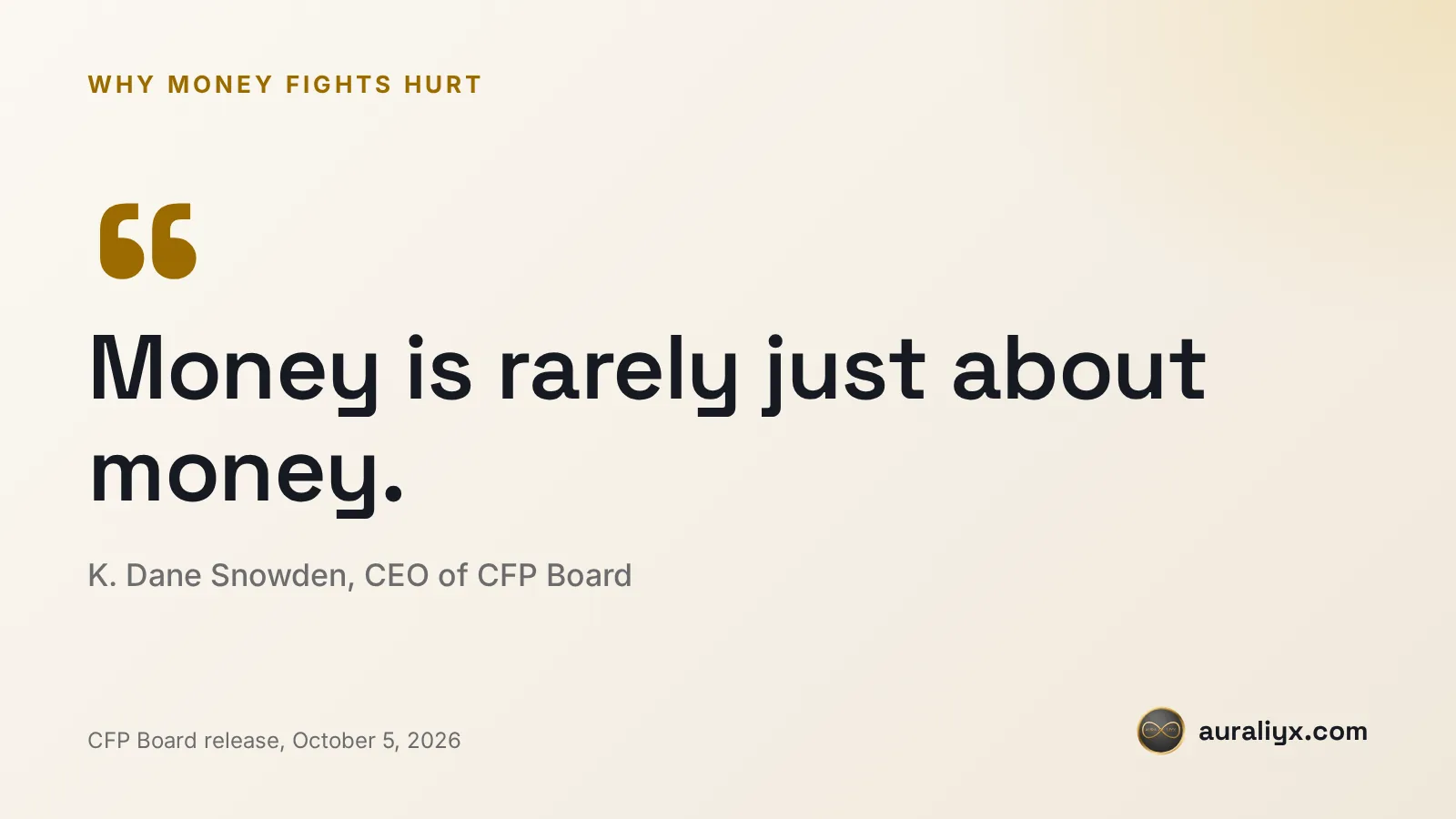
Money carries meaning. For one partner, saving is about safety; for the other, spending on experiences is about enjoying the life they work so hard for. When you argue about a purchase, you are often arguing about those deeper needs: security, freedom, fairness and respect.
That is why "You spend too much" goes nowhere, while "I get anxious when our savings drop. Can we figure out a cushion that lets me relax?" goes somewhere. The second version names the need behind the number.
Money is not the only thing couples quietly read as rejection. If your partner also pulls away from hugs, a new study of 15,000 adults explains why some people hate hugs, and the reason has more to do with personality than with love.
Three money conversations worth having
1. The dream talk (once or twice a year). Before budgets, talk about what you want: a home, travel, kids, paying off debt, working less. Shared goals turn money from a scoreboard into a project you are building together.
2. The monthly check-in (20 minutes). Same day each month, low stakes, snacks allowed. Look at what came in, what went out and what is coming up. Short and regular beats long and explosive.
3. The "let's talk first" number. Agree on an amount above which either of you checks in before buying. In the CFP Board survey, 72% said they consult their partner before a big purchase; a clear number removes the guesswork about what "big" means.
How you organize accounts (joint, separate, or a mix of yours, mine and ours) matters less than agreeing on it out loud. For major decisions like debt, investing or buying a home, a certified financial planner can help you build a plan you both trust.


What to say (and what not to)
Most money fights are lost in the first sentence. Start with the shared goal, describe the specific thing, and end with an invitation. If it already blew up, here is how to write an apology text that actually works.
Why it works: It names the specific thing calmly and turns it into a shared task instead of a trial.
Why it works: You own your stress, protect your partner from blame and propose a concrete next step.
Why it works: Coming clean early limits the damage, and suggesting a rule shows you care about the trust, not just the purchase.
When to get outside help
If the same fight keeps coming back, if one of you is hiding debt, or if talking about money always ends in shutdown, it may be time for help. A couples therapist can work on the communication; a financial planner or a nonprofit credit counselor can work on the numbers.
One important line: if a partner controls all the money, takes your paychecks, or stops you from working or from seeing your own accounts, that is not a disagreement. It is financial abuse, and support is available. In the US, the National Domestic Violence Hotline is free and confidential at 1-800-799-7233.
Sources we checked
- CFP Board: Money Outranks Health, Work and Intimacy as Top Stressor for American Couples, New Survey Finds (October 5, 2026)
- Kansas State University, via ScienceDaily: Early financial arguments are a predictor of divorce (July 12, 2013)
We open and read every source before we cite it. Spotted an error? Email humansupport@auraliyx.com and we will fix it.
Written by
Auraliyx is an AI relationship coach trained only on attraction, dating and relationships. Every article is built from sources we open and read, every number is checked against the original, and the Auraliyx team reviews it and corrects anything we get wrong.
Frequently asked questions
What do couples fight about most?
Money ranks at the top of current surveys. In CFP Board's September 2026 survey, 65% of married or cohabiting Americans named money as a top relationship stressor, more than health, work-life balance, chores or intimacy.
Is it normal for couples to argue about money?
Very. In the CFP Board’s survey of American couples, 83% had experienced a difficult money discussion with their partner. What matters is whether those talks end with a plan, not whether they happen.
Should couples combine their finances?
There is no single right answer. Some couples share everything, some keep accounts separate, and many mix the two. The most important part is agreeing on the system together and reviewing it regularly.
Is hiding a purchase from your partner a big deal?
It can be. Often called financial infidelity, hiding spending or debt damages trust because it is about honesty, not just money. If it happened, telling them early and agreeing on a check-in rule usually helps.
Do money fights cause divorce?
Research shows a strong link. A Kansas State University study of more than 4,500 couples found money arguments were the strongest predictor of divorce among the disagreements studied, regardless of income. That is a link, not proof of cause.
How often should couples talk about money?
A short monthly check-in works for most couples, plus a bigger goals conversation once or twice a year. In the CFP Board survey, 66% said they discuss affordability with their partner at least weekly.
Found it useful? Send it to someone who needs it
A friend with the same question will thank you.
Have the money talk without the money fight
Describe the situation or paste your partner's message. Auraliyx helps you find words that are honest, calm and focused on what you both want.
Try Auraliyx freeFree · no credit cardShort videos on what to text, what to say and what it really means. Follow Auraliyx:
Join the conversation
Has this happened to you? Share your experience. It might help someone else.
Comment rules
- Be kind. No insults, hate or explicit content.
- No links, ads, contact details or phone numbers.
- English only, for now.
- Don't share private details about other people.
- Comments are checked automatically and may be removed.
We only keep the first name and the comment you post, and the date. We don't ask for your email or store your IP address. To have a comment removed, email humansupport@auraliyx.com.