The Mental Load in Relationships: Why the Invisible Work May Matter More Than the Dishes
A two-part study of 452 women and 156 couples in the U.S. and U.K. links a fairer split of the mental load (the planning, remembering and emotional care behind a home) to women’s relationship satisfaction more strongly than who does the chores. Here’s what it found and how to talk about it.

The mental load in relationships is the invisible work of running a shared life: noticing what needs doing, planning, scheduling and remembering, plus emotional work like checking in on your partner. A 2026 study of 452 women and 156 couples found that women reported higher relationship satisfaction when this load was shared more evenly, and it predicted their satisfaction more strongly than who did the physical chores. The study shows a link, not a cause. The practical lesson: share whole responsibilities, not just tasks.
- A new study of 452 women and 156 couples linked a fairer split of the mental load to higher relationship satisfaction for women.
- The mental load predicted women’s satisfaction even after accounting for who does the physical chores.
- Both partners agreed that women carried more of it, but men reported more satisfaction when their partner carried more.
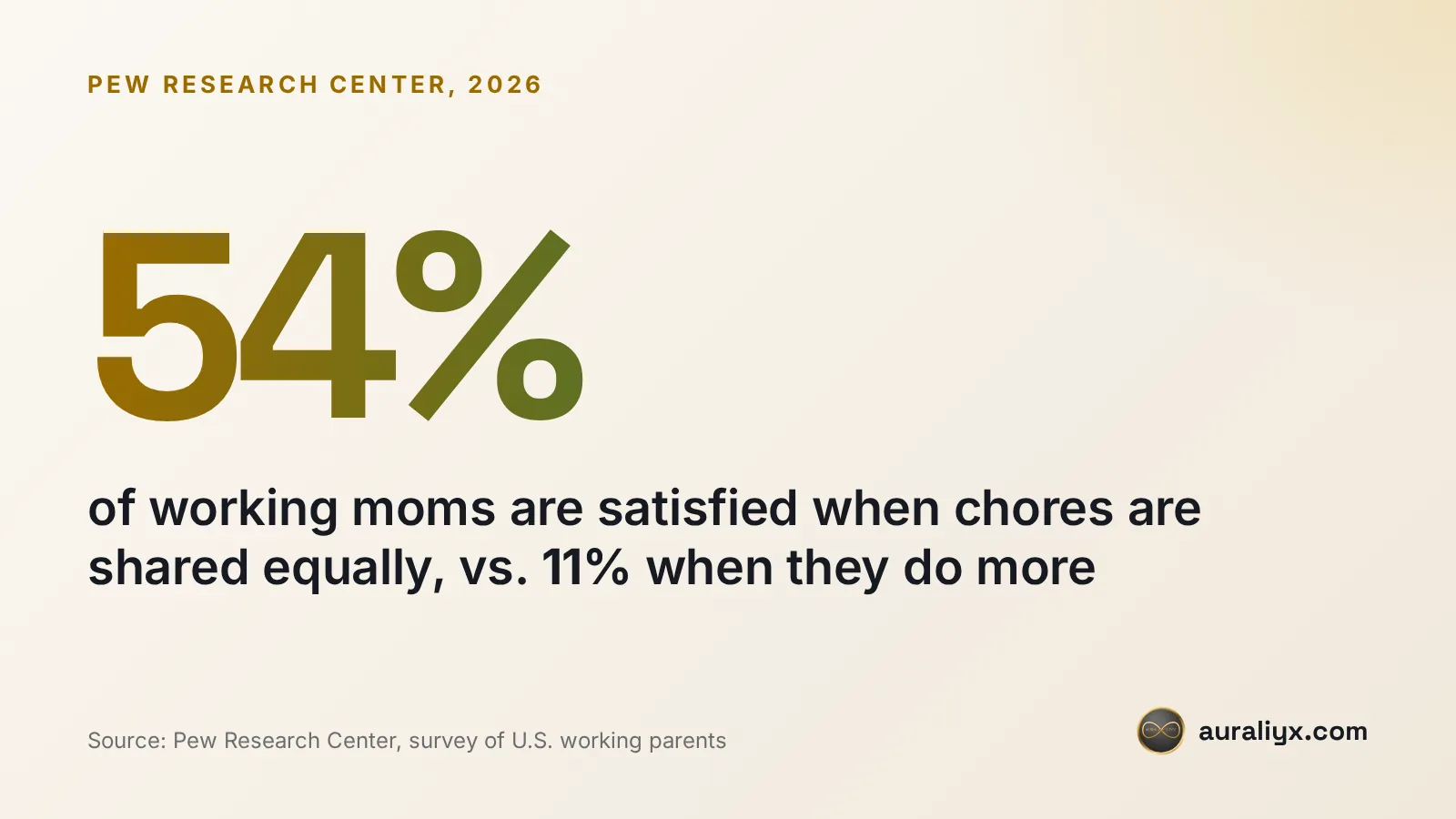
- In a Pew survey of working parents, 54% of moms who split chores equally were satisfied, vs. 11% of moms who did more.
- The fix is sharing responsibility, not just tasks: if you have to remind, you are still carrying it.
It’s 10 p.m., the dishes are done, and you’re lying in bed running a list: the school form, a birthday gift for your partner’s mom, the fact that you’re almost out of coffee. Your partner is already asleep. On paper, the chores are “shared.” So why are you this tired?
That invisible to-do list has a name: the mental load. And a new study suggests it may matter more for how happy women feel in their relationship than who actually does the dishes.
What the new mental load study found
The research, led by Verena Klein of the University of Southampton and published in the journal Personality and Social Psychology Bulletin, was reported by PsyPost on October 9. It looked at heterosexual couples who live together and asked a simple question: does the mental load predict how satisfied people feel, separately from physical housework?
The first study surveyed 452 women in the U.K. who lived with a male partner. Women reported higher relationship satisfaction when their partners were more involved in the mental load of the relationship. When the researchers looked at mental load, physical chores and attitudes about gender roles at the same time, mental load was the only one that predicted women’s satisfaction.
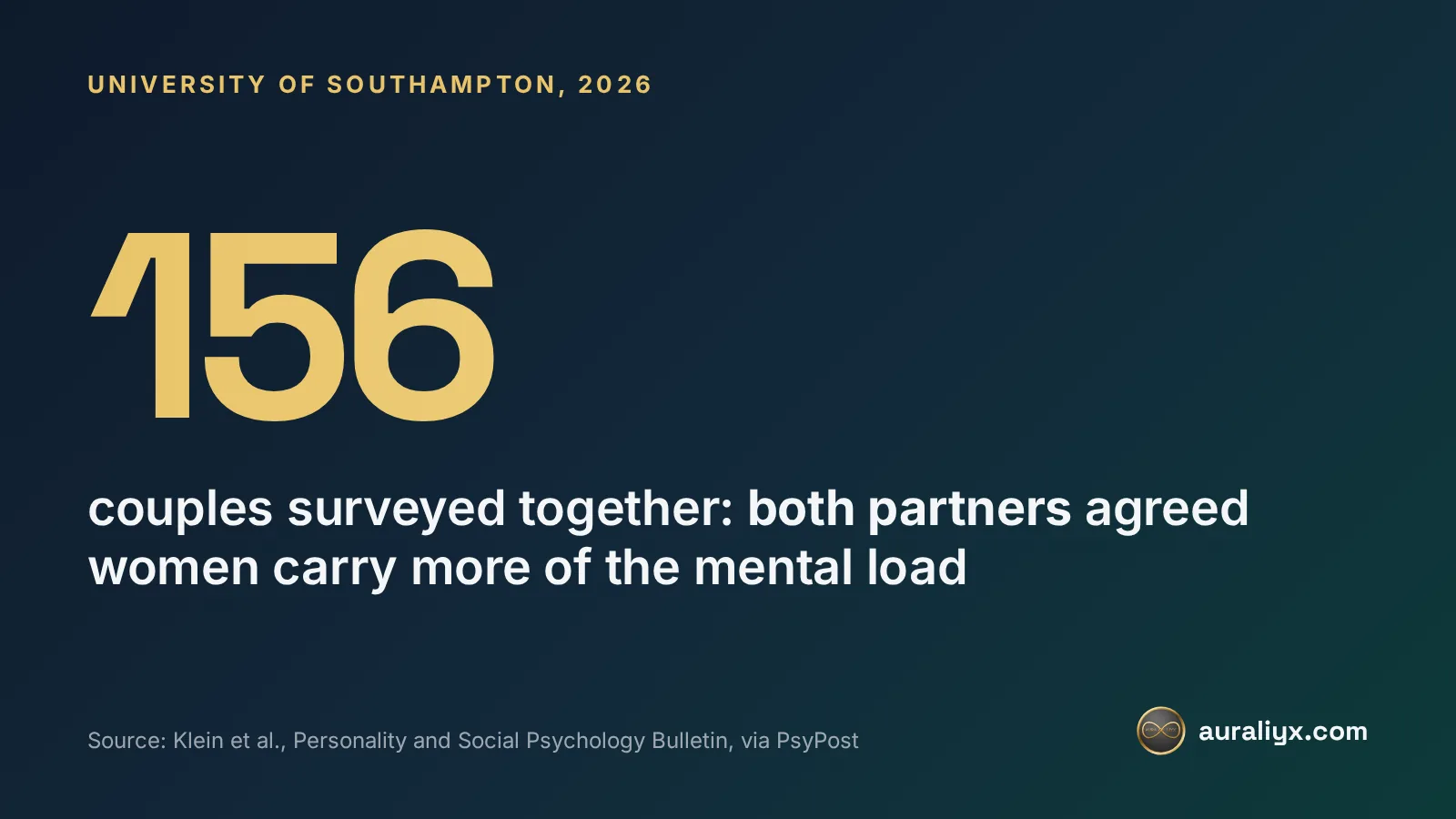
The second study surveyed both partners in 156 couples from the U.S. and U.K. For women, relationship satisfaction was highest when the mental load was shared equally. The associations were modest in size, and the design can’t prove cause and effect, but both studies pointed in the same direction.
What counts as mental load in a relationship?
Researchers describe the mental load as the nonphysical work of running a life together. It mixes cognitive labor, like anticipating what the household needs, booking appointments and organizing routines, with emotional labor, like reassuring people, calming family tension and noticing how your partner feels.
The study’s scale covered five areas: family management, household management, emotional care for children, emotional care for your partner and nurturing the relationship itself. Unlike the dishes, this work has no clear end point. You can finish the laundry. You never finish remembering.
- Noticing that you’re almost out of coffee, diapers or dog food
- Remembering birthdays, school forms and vet appointments
- Planning the weekend, the holidays and date night
- Sensing that your partner had a rough day and checking in
Not sure how to bring up the invisible work without a fight? Describe what’s going on and get the right words.
Try Auraliyx free →Both partners agreed. They just felt it differently
One of the clearest findings: men and women in the couples study agreed that women handled more of the mental load. On the study’s scale, where 3 meant an equal split, women rated the relationship mental load at 2.31 (they did more) and men rated it at 3.36 (their partner did more). The gap was even wider for the mental load of parenting.
But the same arrangement didn’t feel the same to both people. Women were happiest when the relationship mental load was split equally, while men reported greater relationship satisfaction when their female partners carried more of it. Klein cautioned against reading that as men consciously wanting their partner to do everything. It shows that one imbalance can land very differently on each person.
Another surprise: women’s beliefs about gender roles barely explained who carried the mental load. Even women with egalitarian views often ended up holding more of it.
A Pew Research Center survey of U.S. working parents, from March 2026, found a similar gap with chores. In different-sex couples where both parents work full time, 43% said the mom does more of the household chores, 17% said the dad does, and 40% said it’s about equal. Most moms (63%) said they handle more themselves, while dads were much more likely to say things are split evenly. Fairness was tied to satisfaction there, too: moms were far more often satisfied with the chore split when it was shared about equally than when they did more (54% vs. 11%).
“You don’t have to believe that you should be responsible for these things to end up being responsible for them.”
Verena Klein, University of Southampton, to PsyPost
What this study can’t tell you
These are useful findings, but they come with real limits worth knowing before you bring them up at dinner:
- It shows a link, not a cause. Both studies were one-time surveys. Happier couples may simply talk more and end up dividing things more fairly.
- It only looked at different-sex couples living together in the U.S. and U.K.
- The mental load scale is new. It was built for this study, and an outside expert, Geoff MacDonald of the University of Toronto, noted it may partly capture something broader, like how responsive or conscientious a partner is.
- Satisfaction was measured with single questions, which is a fairly rough tool.
- Hours at paid work weren’t tracked, and they could affect how much time each partner has to manage home life.

How to talk about the mental load without starting a fight
Klein’s first suggestion is to make the invisible work visible. Go beyond who does the laundry and ask who notices it’s piling up, remembers which clothes can’t go in the dryer and makes sure it actually gets done.
Pick a calm moment, not the minute you find the empty milk carton. And talk about specifics, not character. “You never help” invites a defense. “I’ve been the one tracking every school form this fall, and I’m worn out” invites a conversation.
Money often sits in the same invisible pile: tracking bills, planning holiday spending, worrying about the budget. It’s couples’ top stressor this year, and it deserves its own calm conversation.
Why it works: It names the invisible work with examples, avoids blame and asks for ownership instead of occasional help.
Why it works: Asking to be told what to do keeps the planning on your partner. Offering to own something takes it off their mind.
Share responsibility, not just tasks
Klein draws an important line between dividing tasks and dividing responsibility. If one partner still has to remind the other, they are still carrying part of the mental load. Help that needs to be managed isn’t really help.
A few habits make the split more real:

- Hand over whole areas. One of you owns the car, the other owns the kids’ doctor visits, from noticing to booking to follow-up.
- Make the list visible. A shared calendar or note turns what lives in one person’s head into something you can both see.
- Check in weekly. Ten minutes on Sunday to look at the week ahead beats a dozen reminders.
- Count the emotional work. Planning date night, checking in after a bad day and keeping in touch with family are part of the load.
- Revisit it. A new baby, a new job or a move changes who has time for what.
If your partner says you’re not pulling your weight
Hearing “I’m doing everything” can sting, especially if you do plenty of chores. Try not to argue the scoreboard. Your partner may be talking about a different kind of work, the kind you can’t see.
Ask what they’re tracking that you didn’t know about, then pick something to own completely. Remember that care looks different for everyone: some people genuinely dislike hugs, so part of the emotional work is learning what actually makes your partner feel looked after.
If you dropped the ball, a short, honest apology goes a long way. Here’s how to write an apology text that doesn’t make things worse. And if their messages have gone short and flat lately, read what a cold reply from your partner can mean.
Why it works: It takes responsibility without excuses and removes the task from your partner’s head for good.
Sources we checked
- PsyPost: The invisible chore that may matter more for women’s relationship happiness than housework (October 9, 2026)
- Pew Research Center: How working parents divide family responsibilities (June 16, 2026)
We open and read every source before we cite it. Spotted an error? Email humansupport@auraliyx.com and we will fix it.
Written by
Auraliyx is an AI relationship coach trained only on attraction, dating and relationships. Every article is built from sources we open and read, every number is checked against the original, and the Auraliyx team reviews it and corrects anything we get wrong.
Frequently asked questions
What is the mental load in a relationship?
It’s the invisible work of running a shared life: noticing what needs doing, planning, scheduling and remembering, plus emotional work like reassuring family members and checking in on your partner.
Does the mental load affect relationship satisfaction?
A 2026 study in Personality and Social Psychology Bulletin linked a fairer split of the relationship mental load to higher relationship satisfaction for women. It is based on surveys, so it shows a link, not proof that one causes the other.
Who usually carries the mental load?
In the study’s couples, both women and men reported that women carried more of it. A Pew Research Center survey of working parents found a similar pattern with household chores.
Is the mental load the same as doing chores?
No. Chores are the doing; the mental load is the noticing, planning and remembering. In the study, mental load predicted women’s satisfaction even when physical housework was taken into account.
How do I bring up the mental load with my partner?
Choose a calm moment, use specific examples and ask your partner to fully own a few areas, start to finish, instead of asking for occasional help.
Can a shared calendar reduce the mental load?
It can help by making invisible tasks visible to both of you. It works best when each person owns specific areas, so nobody has to keep reminding the other.
Found it useful? Send it to someone who needs it
A friend with the same question will thank you.
Ask for a fairer split, kindly
Paste your partner’s message or describe what you’re carrying. Auraliyx helps you say it clearly and calmly, so the conversation leads to change instead of a fight.
Try Auraliyx freeFree · no credit cardShort videos on what to text, what to say and what it really means. Follow Auraliyx:
Join the conversation
Has this happened to you? Share your experience. It might help someone else.
Comment rules
- Be kind. No insults, hate or explicit content.
- No links, ads, contact details or phone numbers.
- English only, for now.
- Don't share private details about other people.
- Comments are checked automatically and may be removed.
We only keep the first name and the comment you post, and the date. We don't ask for your email or store your IP address. To have a comment removed, email humansupport@auraliyx.com.